
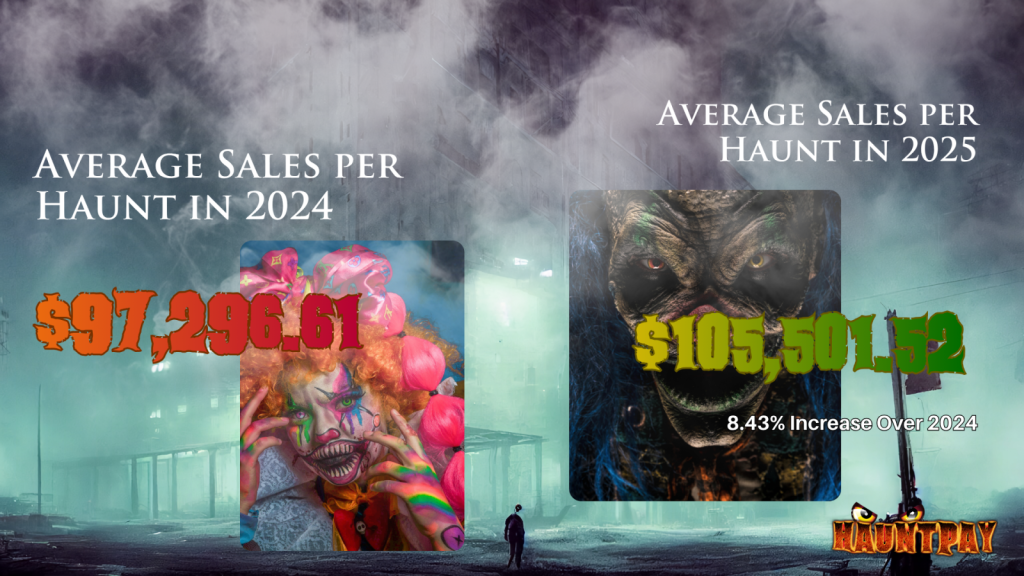
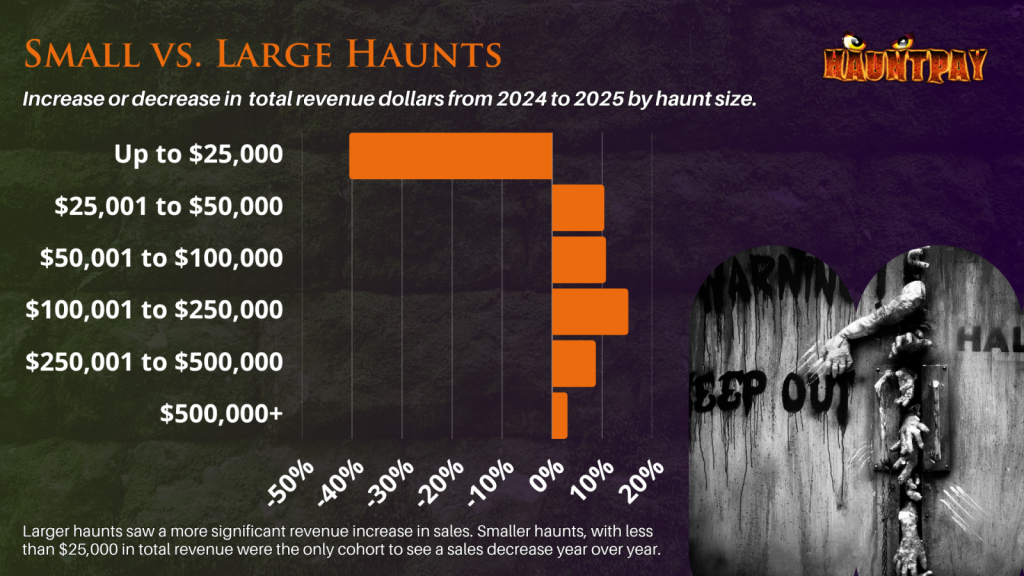
When we look at the 2025 Haunt Industry Report, one message is written in blood. Larger haunts are experiencing explosive revenue growth, while smaller haunts (those pulling in under $25,000) represent the only cohort in the entire country to see their sales drop year-over-year.
This isn’t a random anomaly. We are witnessing a structural shift in the business of fear…a phenomenon we’re call “The Big Squeeze.”
And just to be clear, this isn’t the kind of squeeze you’d want, like a big hug from a larger-than-life monster. This squeeze is draining the life out of some of our favorite small haunts. Let’s unpack the operational mechanics behind why this is happening and what it means for the future of the industry.
| Small Haunts (<$25k) | Mega Haunts ($500k+) |
| ❌ Hit hardest by regulatory & insurance cost spikes | ✅ Capital reserves to absorb compliance costs & scale |
| ❌ Face declining YOY sales due to limited capacity | 🚀 Capturing massive market share & driving tech growth |
Connecting the Dots: The Lifespan Link
If this pattern sounds familiar, it’s because it perfectly aligns with our recent deep-dive into haunt lifespans. In that post, we looked at how the 3–5 year mark acts as a brutal “Valley of Death” for younger attractions.
When a haunt hits its fourth or fifth season, it faces a massive surge in hidden costs, from skyrocketing insurance premiums to sudden county zoning crackdowns. The data proves that these operational hurdles are accelerating industry consolidation. While legacy titans have spent decades building the financial armor to absorb these shocks, smaller, younger operations are hitting a capital wall, getting squeezed completely out of the market.
The Biggest Barriers: Tech and Scale
The modern haunt enthusiast has been completely conditioned by high-production theme park events, immersive entertainment, and major pop-culture spectacles. To meet these massive expectations, legacy mega-haunts are aggressively investing in high-end animatronics, intricate projection mapping, virtual or augmented reality elements, and multi-attraction midways.
These high-tech additions are incredibly effective at driving crowds, but they carry a hefty price tag.
Larger haunts can easily absorb a $20,000 layout upgrade because they have the scale and volume to distribute that fixed cost across tens of thousands of visitors. For a smaller haunt pulling in under $25,000 in total seasonal revenue, investing in modern tech is mathematically impossible. This leaves smaller, old-school attractions relying strictly on classic performance acting and basic static props. While there will always be an artistic charm to raw, grassroots haunts, they are increasingly finding themselves outgunned in the fight for mainstream consumer attention.
Why Compliance Costs Can Be Deadly for the Little Guys
The true engine driving industry consolidation isn’t just consumer preference…it’s the skyrocketing cost of baseline business compliance.
The critical difference is that cost spikes act as asymmetric warfare:
- To a Mega-Haunt: An unexpected $5,000 regulatory demand from a local fire marshal or a premium spike from an insurance underwriter is an annoying line-item deduction from their massive end-of-year profits. It’s a minor bump in the road.
- To a Small Haunt: That exact same $5,000 demand can equal 20% to 30% of their entire seasonal revenue. It is a devastating financial blow that wipes out their entire profit margin, forcing them to consider packing up the hearse and selling out.
Because the regulatory floor keeps getting higher and more expensive to stand on, smaller hobbyist operations are getting priced completely out of the market.
Why Big Haunts Keep Getting Bigger
Larger haunts aren’t just surviving; they are actively widening the gap by deploying advanced digital operational strategies that smaller operations have been slow to adopt.
According to the report data, premium upsales like VIP skip-the-line passes and digital timed ticketing infrastructure are heavily utilized by larger entities to completely bypass structural space limitations and maximize peak-night revenue. Larger operations are also leading the charge into lucrative off-season events (like Krampus, Valentine’s Day, or year-round escape rooms), transforming a seasonal October pop-up into a resilient, year-round corporate enterprise.
When a corporate haunt builds a reliable, multi-season revenue stream, they generate an enormous war chest. They can buy up more local ad placements, secure prime commercial real estate, outbid smaller operators for top-tier acting talent, and comfortably absorb rainy October weekends that trigger unexpected customer refunds.
How HauntPay Capital Can Help Smaller Attractions Compete
If you are running an independent, smaller attraction, this data might feel like a death sentence. But you don’t have to face the consolidation beast unarmed!
The biggest advantage the big guys have is immediate access to cash flow. That is exactly why we created HauntPay Capital.
We know that independent haunters don’t have time to jump through the agonizing hoops of traditional bank loans just to pay for an emergency zoning fix or fund a high-impact summer marketing campaign. HauntPay Capital gives you fast, hassle-free access to the funding you need to grow your haunt..at any size. Whether you need to invest in premium animatronics to upgrade your show, cover an unexpected insurance spike, or secure a better piece of commercial real estate, this program provides the cash infusion required to stand your ground against corporate competitors.
You don’t need a corporate empire to compete like one…you just need the right funding partner in your corner.
Is the Independent Haunt Dead?
Not yet! But the era of successfully running a haunted house as a casual, part-time hobby on a wing and a prayer is definitely changing. To survive “The Big Squeeze,” smaller and mid-sized haunts must actively stop thinking like hobbyists and start operating with the exact same data-driven business discipline as the multi-million dollar corporate attractions.
That means maximizing your order values by pushing sales entirely online, using smart digital tools to optimize your lines, and leveraging programs like HauntPay Capital to fund your growth before the season leaves you behind.
What side of the consolidation line does your business sit on, and what trends are you seeing in your local market? Help us provide independent haunters with the defensive metrics they need to thrive by sharing your input in the 2026 Haunt Industry Survey today!